ad
By @beauties · 15/09/2026 06:39 AM
♥ 0 likes↓ 0 dislikes◉ 3 views
Primary prompt
Create an ultra-realistic photographic recreation of the supplied reference image. Match the reference image extremely closely in composition, camera angle, framing, subject positioning, body posture, clothing, facial expressions, lighting, colors, background, proportions, and overall visual appearance. Do not redesign or reinterpret the scene.
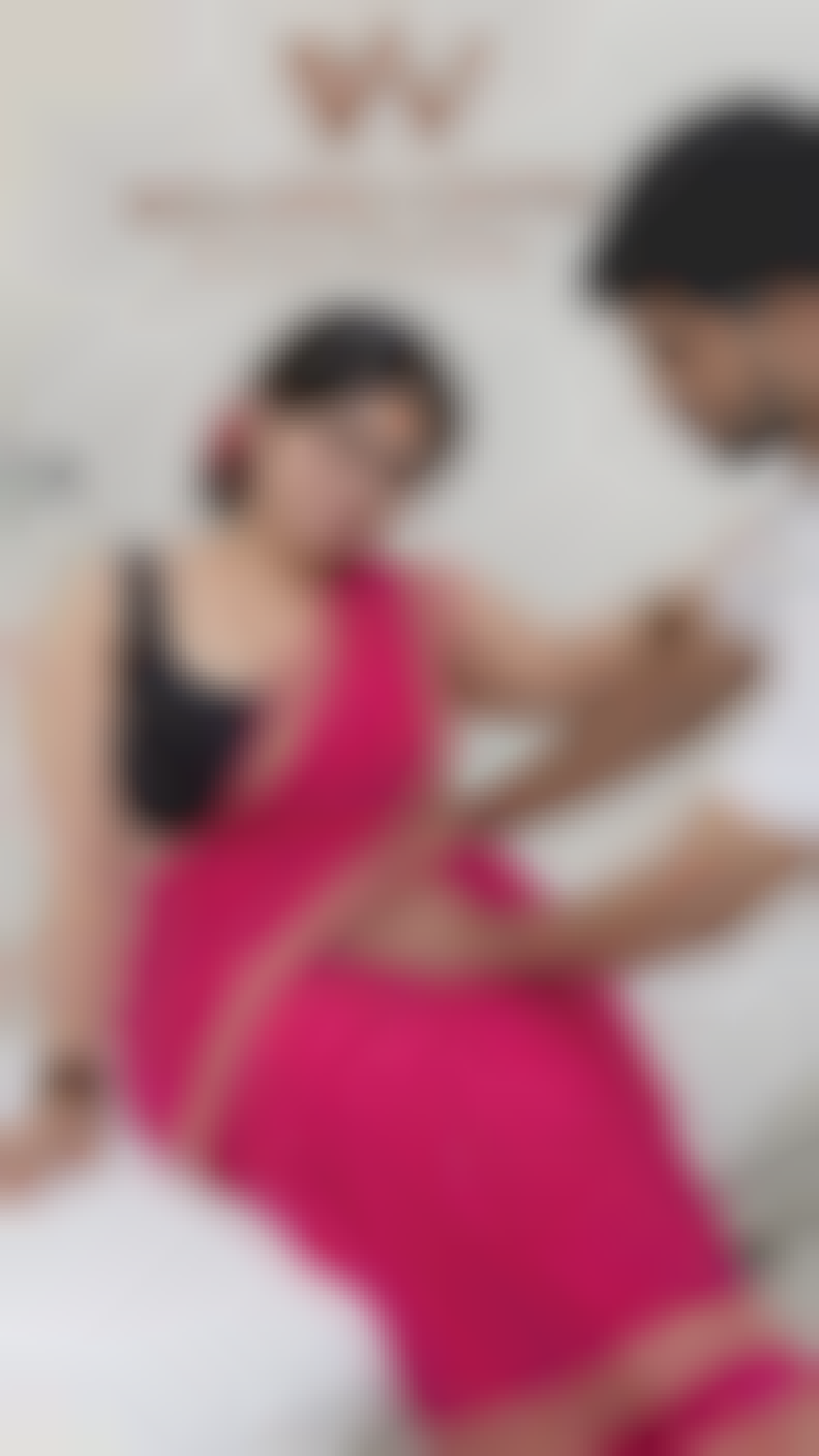
A realistic Indian wellness/physiotherapy treatment scene inside a clean, bright, modern wellness center. The photograph is vertically framed, approximately 9:16, with the subjects occupying the central and lower portion of the frame.
Main female subject: an adult Indian woman seated upright on a white medical examination/treatment bed. She has a fuller/curvy body type and medium-light warm Indian skin tone. Her black hair is neatly pulled back into a low bun, with a red flower/gajra-like decoration visible behind her ear/bun. She wears thin black-rimmed rectangular/oval eyeglasses, a small round black bindi centered on her forehead, small traditional earrings, and multiple gold/brown bangles on her wrists. Her eyes are closed and her facial expression is calm, relaxed, and slightly serene, as though receiving a therapeutic treatment.
She is wearing a bright hot-pink/magenta Indian sari with an ornate golden-beige embroidered border, draped naturally around her body. The sari has visible folds and realistic fabric texture. Underneath it she wears a plain black sleeveless blouse with a rounded/deep scoop neckline. The sari is wrapped around her waist and legs and spreads naturally across the treatment bed. The golden border is clearly visible along the pallu and lower sari, with small decorative golden motifs on the pink fabric.
Her left arm extends downward beside her body, with her hand resting on the white treatment surface. Several bangles are visible around her wrist. Her other arm is bent upward toward the male therapist, with her hand resting lightly against his upper arm/shoulder area.
Male therapist: an adult Indian man positioned on the right side of the frame, shown in a three-quarter side profile. He has short, thick black hair, neatly trimmed facial hair/stubble, medium Indian skin tone, and a focused professional expression. His head is tilted downward as he concentrates on the treatment.
He wears a plain clean white short-sleeve polo/T-shirt, with no visible logo or text. His torso is partially cropped by the right edge of the frame. One of his hands is placed gently and professionally on the woman's lower abdomen/waist area, while his other arm reaches across toward her upper arm/shoulder area. His hands and fingers should look anatomically natural and realistically positioned.
Interaction and pose: reproduce the exact therapeutic positioning shown in the reference. The woman remains seated on the examination bed while the therapist performs a gentle wellness/physical-treatment maneuver around her abdomen/waist region. The pose must look like a legitimate professional wellness or physiotherapy treatment, natural and non-sexual.
Background: a pristine white/off-white wellness center interior. On the wall behind the subjects is a large minimalist rose-gold/brown stylized “W” logo near the upper center. Beneath/around the logo is large wall lettering reading:
“WELLNESS CENTRE”
and underneath, smaller lettering:
“at your doorstep”
Match the approximate typography, spacing, size, placement, perspective, and muted rose-gold/brown color from the reference. The wall lettering should appear physically mounted/printed on the wall with subtle dimensionality.
On the far left background, include a small white counter/shelf with several tiny wellness/medical bottles and containers, softly blurred. Keep these background objects subtle and secondary.
Treatment bed: large white padded medical treatment/examination bed with a clean white sheet. The woman is seated on it. The lower foreground shows the curved/raised edge of the treatment bed and a small amount of its mechanical structure, matching the reference.
Camera: eye-level/upper-body documentary photography perspective, approximately 50–70mm portrait lens, natural perspective, medium distance, vertical composition. Keep the same camera height and viewpoint as the reference. No dramatic wide-angle distortion.
Lighting: bright, soft, diffused indoor lighting, predominantly clean white ambient light. Very soft shadows, even skin illumination, realistic highlights on the sari and white clothing. Premium commercial wellness-center photography aesthetic.
Image quality: extremely photorealistic, natural Indian skin texture, realistic pores, realistic hair strands, realistic hands and fingers, physically accurate fabric folds, detailed sari embroidery, natural shadows, realistic reflections on eyeglasses, accurate anatomy, subtle depth of field, high dynamic range, sharp subjects with a slightly softer background.
Color palette: predominantly clean white/off-white surroundings contrasted strongly by…